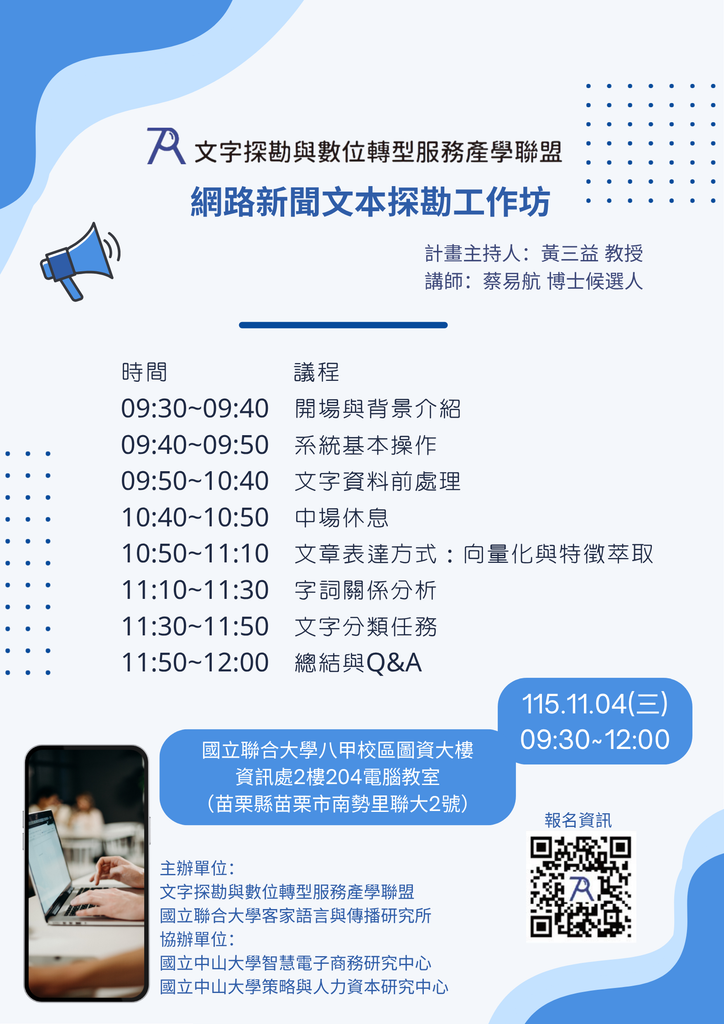
Date & Time: Wednesday, November 4, 2026, 9:30 AM–12:00 PM
Venue: Library and Information Building, Bajia Campus, National United University
In 2026, the Text Mining and Digital Transformation Service Industry-Academia Alliance joined hands with the Graduate Institute of Hakka Language and Communication at National United University to organize the “Online News Text Mining Workshop.” The workshop aimed to promote the application of text mining technologies in online news and communication. Through a structured curriculum, participants were guided through practical processes for text data processing and analysis, enhancing their data analysis and application skills.
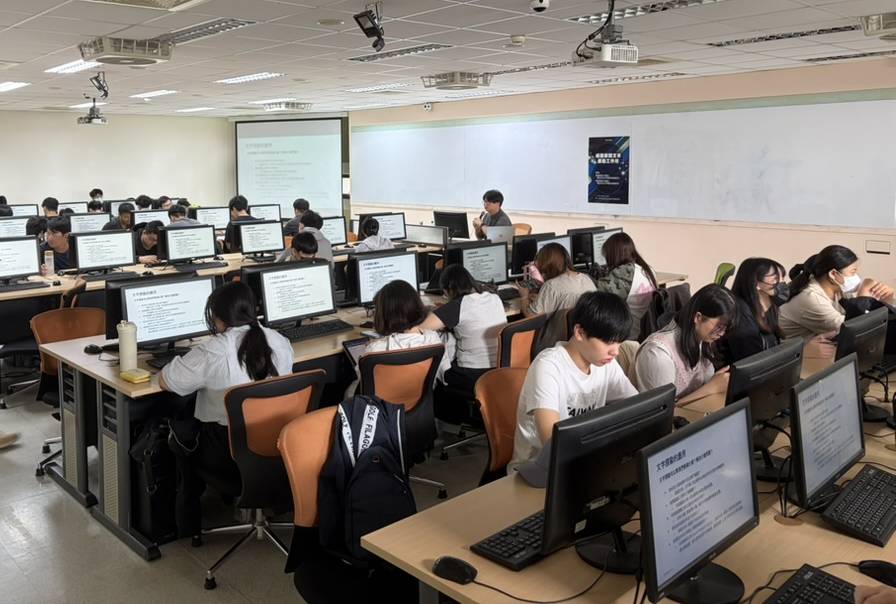
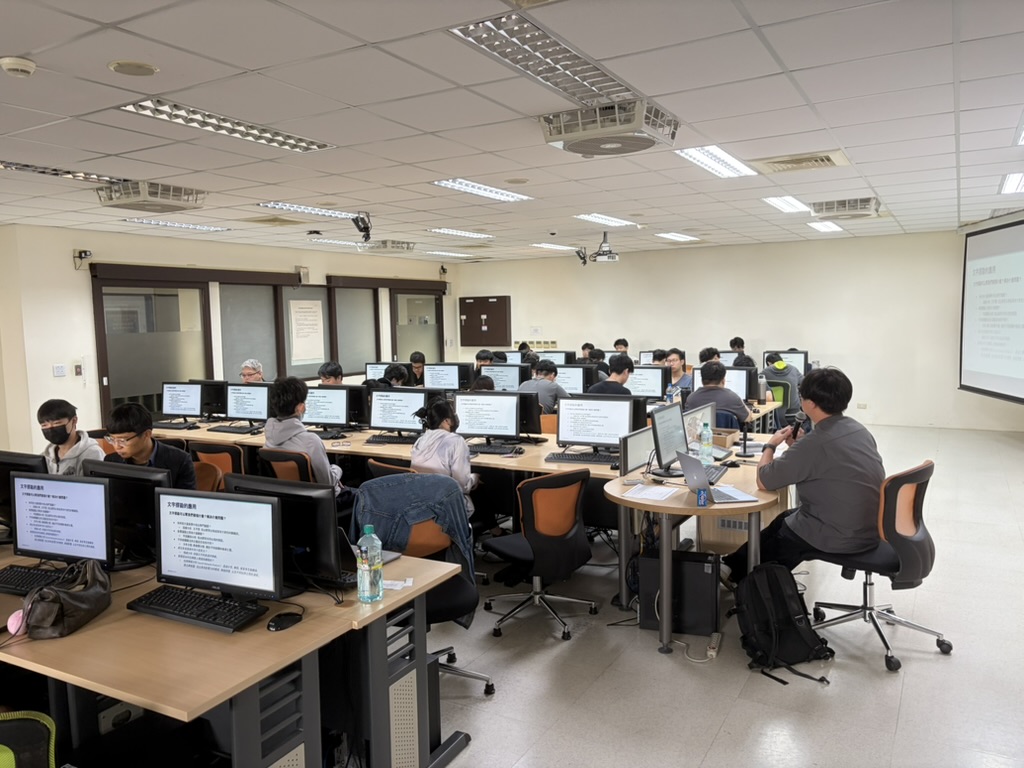
The workshop opened with an introduction to the Tarflow workflow platform by lecturer Dr. Candidate Yi-Hang Tsai. Through system demonstrations and a series of instructional sessions, participants learned about text data processing, word frequency analysis, and text analysis techniques, gaining a better understanding of the potential applications of text mining in practical settings.
The workshop was divided into two sessions: “Introduction to Text Mining” and “Text Analysis and Applications.” Dr. Candidate Chia-Ming Chang served as the on-site teaching assistant, providing guidance and answering participants’ questions throughout the workshop.
The first session introduced the fundamentals of text mining, beginning with an overview of the background and key concepts, followed by basic system operations. Participants then explored text preprocessing and word frequency analysis, learning about the essential steps involved in preparing text data for analysis and identifying important terms and information from large volumes of text.
The second session focused on text analysis methods and their applications. Topics included text representation, vectorization, and feature extraction, explaining how textual content can be transformed into features suitable for analysis. Participants also learned about word relationship analysis to understand associations among terms. In addition, the session introduced text classification tasks, demonstrating how text can be categorized based on its content and how text mining techniques can support information organization and document analysis. Through this progressive curriculum, the workshop connected fundamental system operations with advanced text analysis and classification applications, helping participants build a foundation in text mining and understand its potential applications in teaching, research, and practical work.
The workshop concluded with a summary and Q&A session, providing an opportunity to address participants’ questions and deepen their understanding of text mining technologies and their applications.